While researching for the three articles that I wrote (1, 2, and 3 respectively), I came across the interesting titles the Chola Kings used - which to an extent, serves as witness to their achievements- military & otherwise. Another problem I encountered is with Western Historiography - the use of the "Royal Noble and chivalric titles" as used by Western Scholars cannot be equated to the titles used during medieval/late antiquity periods in European History. What title can you give to, for example, the Zamorin or the Perumal? Are they "Kings?" or "Petty Kings"? Or are they something else entirely? (More on the Problem of Western Historiography in a later article)
So what I'm attempting to do here is not only to provide a window to Chola History, but also [attempt] to provide a ready reckoner for the Chola Emperors ( I'm only examining the titles used by the Medevial Cholas, as even this seems to be a gargantuan task for me. See Note 1 as well)
Below is the list of the Chola Emperors & their titles, till Rajaraja Chola the Great.
Vijayalaya Chola (848 C.E. to 871 C.E.)
After the fall of the ancient Chola Kingdom, it is not known what happened in the interregnum; from almost 200 C.E. to 848 C.E., it is a dark time for the Cholas, thus, historians have used the accounts of the Pandyas and Pallavas, and it is supposed that they ruled the Kaveri heartland as tributaries/feudatories of the the Pandyas/Pallavas.
Vijayala Chola conquered Thanjavur from Elango Mutharaiyar who was the final ruler of Mutharaiyar dynasty. It is said that in the year 852 CE Vijayalaya Chola waged war with the Muttaraiyar king Sattan Paliyilli (826–852 CE) in the neighbouring east, and captured his territory of Thanjavur. While Vijayalaya Chola was a Pallava feudatory, the Muttaraiyan chief was a Pandya feudatory. Making use of the opportunity during a war between Pandyas and Pallavas, Vijayalaya rose out of obscurity and captured Thanjavur.
He used the title Parakesarivarman, a title meant in part to honour his ancestor, Parakesari. Inscriptions under his son exclusively refer him by this name.
Aditya Chola I (871 C.E. to 907 C.E.)
It was under him that the Cholas overthrew the Pallava yoke and achieved independence. He used the title Rajakesari as his primary title, In Inscriptions, he is also called "Tondainadu pavina Rajakesarivarman", "The Rajakesarivarman who overran Tondainadu" Tondainadu, as those ardent fans of Crusader Kings 2 would note, Is the North-Eastern region of Tamil Nadu (see note 2)
The inscirption of his successor, his son, notes him as Thondaimaanaruur thunjina udaiyaar (The King who died at Tondaimanarrur), Tondaimanarrur being the Capital of Tondai nadu. It is thought to be near Sriklahasti, in Chittor, Andhra Pradesh.
Parantaka Chola I (907 C.E. to 955 C.E.)
As his Grandfather, Parantaka Chola I held the title "Parakesari". As early as his Third Regnal year, he is beleived to have invaded and occupied the Capital of the Pandyas, having been given the title "Maduraikondan",and later is described as "Madhurantaka",the destroyer of Madurai - This is after he conducted a successful raid on the Pandya Capital.
After defeating an alliance of the Pandya & Ceylon kings, and after further conducting raid on Lanka, he is described as " Maduraiyum Elamum Konda Parakesarivarman" – Parakesarivarman who conquered Madurai and Sri Lanka. He utilized his war loot to cover the roof of the celebrated Shiva Temple at Chidambaram to be covered with Gold, for this he is described as "Thillaiyambalathhukku pon koorai veiyntha thevan". See Note 3 as well.
Gandaraditya
So what I'm attempting to do here is not only to provide a window to Chola History, but also [attempt] to provide a ready reckoner for the Chola Emperors ( I'm only examining the titles used by the Medevial Cholas, as even this seems to be a gargantuan task for me. See Note 1 as well)
Below is the list of the Chola Emperors & their titles, till Rajaraja Chola the Great.
Vijayalaya Chola (848 C.E. to 871 C.E.)
After the fall of the ancient Chola Kingdom, it is not known what happened in the interregnum; from almost 200 C.E. to 848 C.E., it is a dark time for the Cholas, thus, historians have used the accounts of the Pandyas and Pallavas, and it is supposed that they ruled the Kaveri heartland as tributaries/feudatories of the the Pandyas/Pallavas.
Vijayala Chola conquered Thanjavur from Elango Mutharaiyar who was the final ruler of Mutharaiyar dynasty. It is said that in the year 852 CE Vijayalaya Chola waged war with the Muttaraiyar king Sattan Paliyilli (826–852 CE) in the neighbouring east, and captured his territory of Thanjavur. While Vijayalaya Chola was a Pallava feudatory, the Muttaraiyan chief was a Pandya feudatory. Making use of the opportunity during a war between Pandyas and Pallavas, Vijayalaya rose out of obscurity and captured Thanjavur.
He used the title Parakesarivarman, a title meant in part to honour his ancestor, Parakesari. Inscriptions under his son exclusively refer him by this name.
Aditya Chola I (871 C.E. to 907 C.E.)
It was under him that the Cholas overthrew the Pallava yoke and achieved independence. He used the title Rajakesari as his primary title, In Inscriptions, he is also called "Tondainadu pavina Rajakesarivarman", "The Rajakesarivarman who overran Tondainadu" Tondainadu, as those ardent fans of Crusader Kings 2 would note, Is the North-Eastern region of Tamil Nadu (see note 2)
The inscirption of his successor, his son, notes him as Thondaimaanaruur thunjina udaiyaar (The King who died at Tondaimanarrur), Tondaimanarrur being the Capital of Tondai nadu. It is thought to be near Sriklahasti, in Chittor, Andhra Pradesh.
Parantaka Chola I (907 C.E. to 955 C.E.)
As his Grandfather, Parantaka Chola I held the title "Parakesari". As early as his Third Regnal year, he is beleived to have invaded and occupied the Capital of the Pandyas, having been given the title "Maduraikondan",and later is described as "Madhurantaka",the destroyer of Madurai - This is after he conducted a successful raid on the Pandya Capital.
After defeating an alliance of the Pandya & Ceylon kings, and after further conducting raid on Lanka, he is described as " Maduraiyum Elamum Konda Parakesarivarman" – Parakesarivarman who conquered Madurai and Sri Lanka. He utilized his war loot to cover the roof of the celebrated Shiva Temple at Chidambaram to be covered with Gold, for this he is described as "Thillaiyambalathhukku pon koorai veiyntha thevan". See Note 3 as well.
Gandaraditya
The reccords of the next 30 years of the Cholas are scant; and thus what we know of it is rather skewed ( Reasons noted in Note 4). However, we can reasonably conclude that Gandaraditya used the title : "Rajakesari" as well as "Merkey elundarulina devar" - "the king/lord who was pleased to go west"- for He apparently went to Kerala.
Arinjaya
It is not known for a certainty whether Arinjaya, the third son of Parantaka Chola I ruled, historians assume that he ruled for a short period, in all probability, as an intermediary between his nephew, Uttama Chola I. Arinjaya is described as "Alvar Arikulakesarideva" Rajaraja Chola I, his Grandson. For the Purposes of Clearly understanding the succession of Kings, see Note 5.
Sundara Chola (Parantaka Chola II)
He is credited with laying the foundations of the success his younger son Rajaraja Chola I- he defeated the Pandyas, and assumed the title of Maduraikonatan, as his Grandfather, Parantaka Chola did. He and his son, Aditya Chola II, defeated and routed the Rashtraukatas from Tondainadu. His heir and Co-regent, Aditya Chola II Karikalan was assassinated, (which remains an unsolved mystery), and Sundara Chola is remarked to have died of a broken heart - given the title "Pon maligai thunjina thevar" – "the king who died in the golden palace".
Aditya Chola II
Aditya Chola was co-regent and firstborn son of Sundara Chola, and was co-regent as well. He is remarked to have fought valiantly at Chevur, having, at the age of 12, "played with Veera Pandyan", the title given to him is"Vira Pandyan Thalai Konda Adithha Karikalan" - "The Adithya Karikalan who took the head of Vira Pandayan": Historians state that this does not literally mean he cut the king to size, but rather that he humiliated the King at the battlefield. He is also described as a "Vira Abhimanyu": A brave Abhimanyu, the famous warrior son of Arjun of Mahabharta. (The calligrapher uses a tecchnique which is rather ingenious: Abhimanyu, of course, was a ferocious warrior, who died as he could not escape the Chakravyuha; and he died. Here, Aditya Chola was a ferocious warrior, but his death came in the fame of the Chakravyuaha that was his assassination.)
Uttama Chola
Uttama Chola, the son of Gandaraditya, succeeded Sundara Chola upon his death. Sundara Chola's second son, Rajaraja Chola, was installed as his heir as compensation for being passed over. Uttama is described as Parakesari. He also assumed to have the title "Vikrama".
Rajaraja Chola I "The Great"
Rajarja as I noted here, is one of the greatest Emperors of Indian History. His name is recorded at birth as "Arulmozhi Varman". He is said to have been elected by a democratic process, having served as heir-presumptive as "Yuva-raja" . He first attacked the Cheras at Kanathaur Salai, having used the title "Kandalur -salaik-kalamautta", and "having beheaded the Malai Alargal", Malai Alargal being the Chera Warriors who must have defended Kandalur from the Chola attack ( For a more detailed understanding of the Kandalur War, see Note 6) . He also uses the title "Mummadi Chola-deva" which is thought to be "The Chola who had strength thrice over". He of course, took the title "Rajakesari"as his predecessors had.
After conquering/subjugating the Pandyas and the Cheras, he is called the "Mummudi Cholan" literally, the Suzerain of the 3 kingdoms: Chola, Chera and Pandya.
Rajaraja, by virtue of his tremendous success, is called a variety of titles in inscriptions.
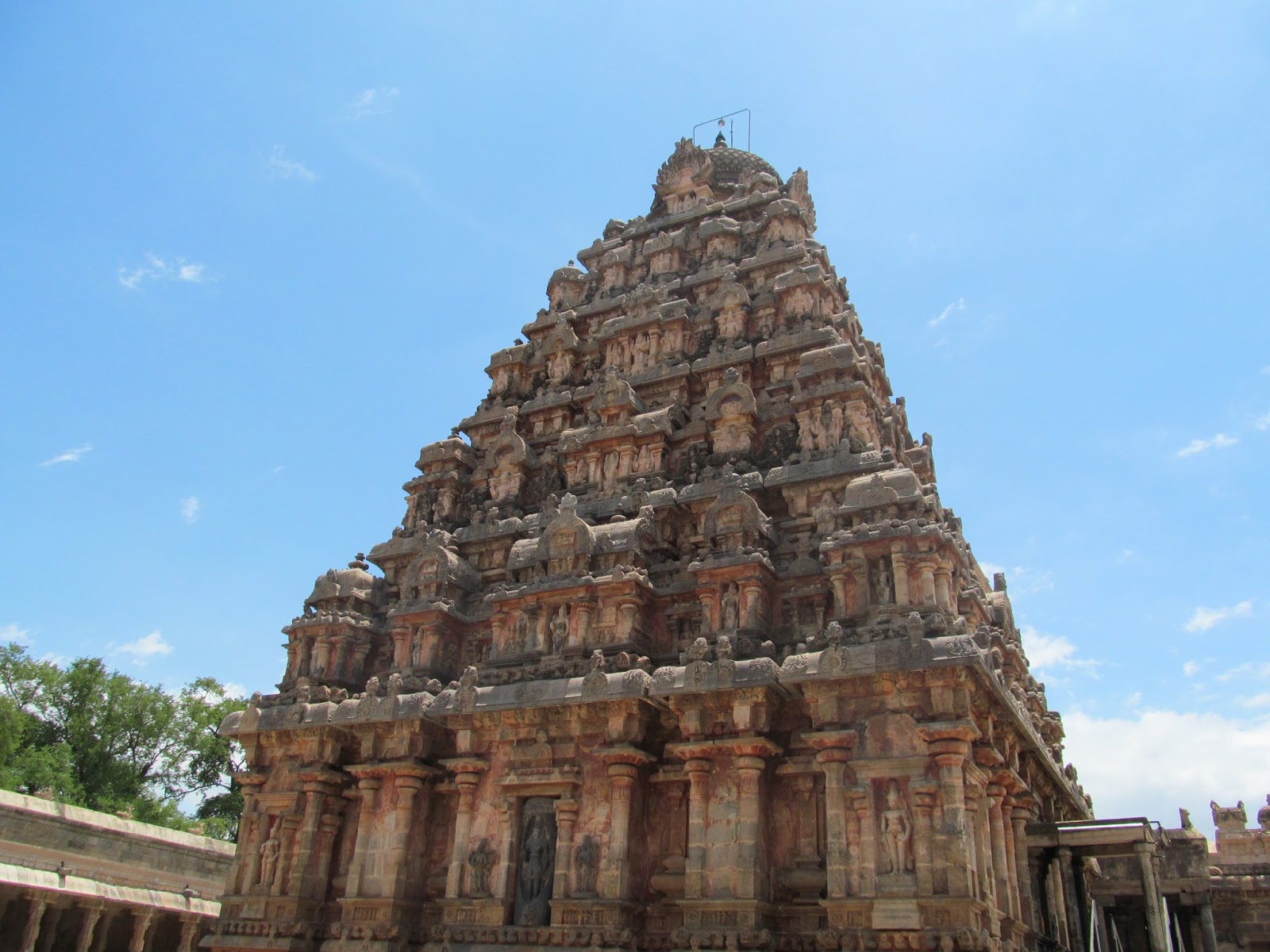
He is also called "Keralantaka" for having subjugated the Cheras, and this Gopura is the Keralanthaka Gopura Constructed in front of the Brihadeeswarar temple:
The other titles used by him are listed and its translations are listed in Table 1.
Arinjaya
It is not known for a certainty whether Arinjaya, the third son of Parantaka Chola I ruled, historians assume that he ruled for a short period, in all probability, as an intermediary between his nephew, Uttama Chola I. Arinjaya is described as "Alvar Arikulakesarideva" Rajaraja Chola I, his Grandson. For the Purposes of Clearly understanding the succession of Kings, see Note 5.
Sundara Chola (Parantaka Chola II)
He is credited with laying the foundations of the success his younger son Rajaraja Chola I- he defeated the Pandyas, and assumed the title of Maduraikonatan, as his Grandfather, Parantaka Chola did. He and his son, Aditya Chola II, defeated and routed the Rashtraukatas from Tondainadu. His heir and Co-regent, Aditya Chola II Karikalan was assassinated, (which remains an unsolved mystery), and Sundara Chola is remarked to have died of a broken heart - given the title "Pon maligai thunjina thevar" – "the king who died in the golden palace".
Aditya Chola II
Aditya Chola was co-regent and firstborn son of Sundara Chola, and was co-regent as well. He is remarked to have fought valiantly at Chevur, having, at the age of 12, "played with Veera Pandyan", the title given to him is"Vira Pandyan Thalai Konda Adithha Karikalan" - "The Adithya Karikalan who took the head of Vira Pandayan": Historians state that this does not literally mean he cut the king to size, but rather that he humiliated the King at the battlefield. He is also described as a "Vira Abhimanyu": A brave Abhimanyu, the famous warrior son of Arjun of Mahabharta. (The calligrapher uses a tecchnique which is rather ingenious: Abhimanyu, of course, was a ferocious warrior, who died as he could not escape the Chakravyuha; and he died. Here, Aditya Chola was a ferocious warrior, but his death came in the fame of the Chakravyuaha that was his assassination.)
Uttama Chola
Uttama Chola, the son of Gandaraditya, succeeded Sundara Chola upon his death. Sundara Chola's second son, Rajaraja Chola, was installed as his heir as compensation for being passed over. Uttama is described as Parakesari. He also assumed to have the title "Vikrama".
Rajaraja Chola I "The Great"
Rajarja as I noted here, is one of the greatest Emperors of Indian History. His name is recorded at birth as "Arulmozhi Varman". He is said to have been elected by a democratic process, having served as heir-presumptive as "Yuva-raja" . He first attacked the Cheras at Kanathaur Salai, having used the title "Kandalur -salaik-kalamautta", and "having beheaded the Malai Alargal", Malai Alargal being the Chera Warriors who must have defended Kandalur from the Chola attack ( For a more detailed understanding of the Kandalur War, see Note 6) . He also uses the title "Mummadi Chola-deva" which is thought to be "The Chola who had strength thrice over". He of course, took the title "Rajakesari"as his predecessors had.
After conquering/subjugating the Pandyas and the Cheras, he is called the "Mummudi Cholan" literally, the Suzerain of the 3 kingdoms: Chola, Chera and Pandya.
Rajaraja, by virtue of his tremendous success, is called a variety of titles in inscriptions.
He is also called "Keralantaka" for having subjugated the Cheras, and this Gopura is the Keralanthaka Gopura Constructed in front of the Brihadeeswarar temple:
 |
| the Keralantka Gopura |